
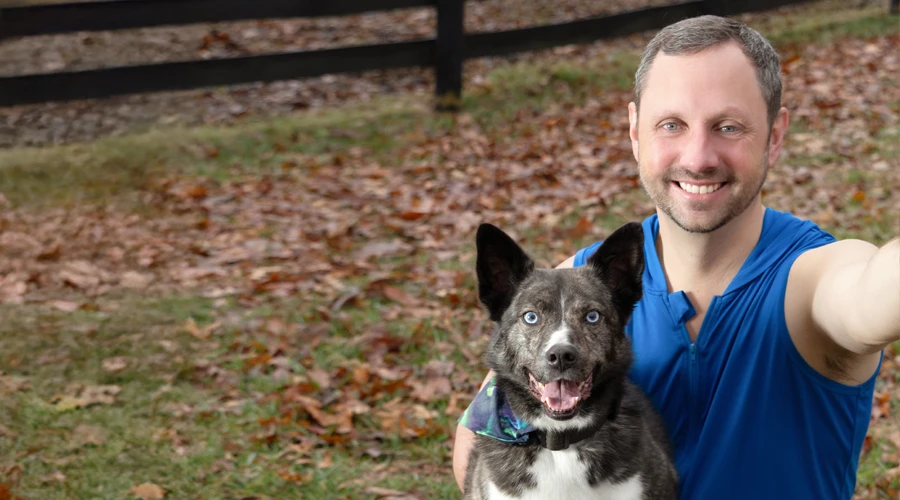
As pet owners, we go to great lengths to ensure our furry companions live healthy, comfortable lives. So, when a beloved dog begins to show signs of osteoarthritis (OA)—limping, difficulty getting up, reluctance to play—we want to do whatever we can to make them feel better and move more comfortably. And veterinarians are no exception in wanting to do the best thing for their own dogs.
Here’s the personal story of Aurora, a lively Husky mix and her owner, Dr. Matt Brunke, DVM, DACVSMR (Canine), CCAT; Diplomate, American College of Veterinary Sports Medicine and Rehabilitation; Fellow, International Association of Veterinary Rehabilitation and Physical Therapy.
About Dr. Matt Brunke
Dr. Brunke practices in the Washington, DC area at Veterinary Referral Associates in Gaithersburg, MD. He earned his DVM from Ross University School of Veterinary Medicine, his certification in rehab from the University of Tennessee CCRP program, and completed the practice experience pathway for the American College of Veterinary Sports Medicine and Rehabilitation. Dr. Brunke is part of the founding faculty for the NC State CCAT Rehab program. He believes in a big picture and practical approach to his patients and enjoys both orthopedic and neurological cases. When not at work, he enjoys spending time with his dogs, Aurora and Penny, a 12-year-old mixed breed. Dr. Brunke can be found online on Instagram @DrBrunke and LinkedIn: Matthew W. Brunke.
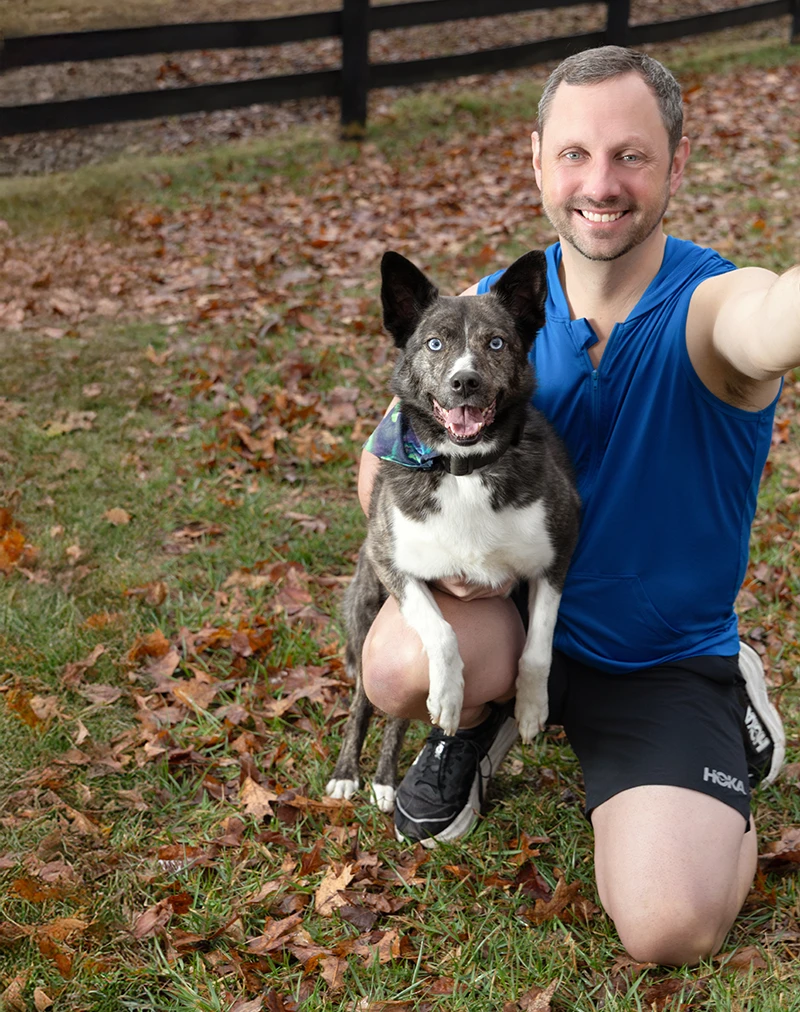
“Aurora is my 5K and 10K running buddy.”
“She’s a crazy, investigative dog. She wants to be everywhere and check everything out. We live in Maryland, so we don’t often get a lot of snow. But this year, her Husky kicked in when she saw snow for the first time. She went nuts, running around in circles. She was so excited to be in her element!”
“Aurora came unexpectedly into my life in April of 2020.”
“I got a call from a shelter on the eastern shore of Maryland asking me to come out and give a second opinion on a 6-month-old Husky who they thought was paralyzed because she couldn’t use her back legs. And I volunteer my time to shelters, so I agreed to drive out to do a physical exam on her. She was literally dragging herself around by her front legs, but I didn’t think she was paralyzed.
“When I checked out her legs, I found that both thigh bones were not right. Then we looked at her X-rays and it was clear that someone had broken both of her femurs and just dumped her.
“This shelter, like most of them, has a limited budget and they had to make a choice. They could either afford to fix Aurora or help many, many other dogs, but they didn’t have the funds to do both. I couldn’t just leave this poor puppy behind. She was coming home with me. I was like, well I guess I have another dog!
“The first part of Aurora’s recovery was getting her out to a great orthopedic surgeon in Missouri who was able to rebreak and reset her right leg which enabled her left leg to naturally straighten as she continued to grow. After that, it took many months of physical therapy, but we were able to teach her how to walk again! And, within 2 years, Aurora had become my running companion.”
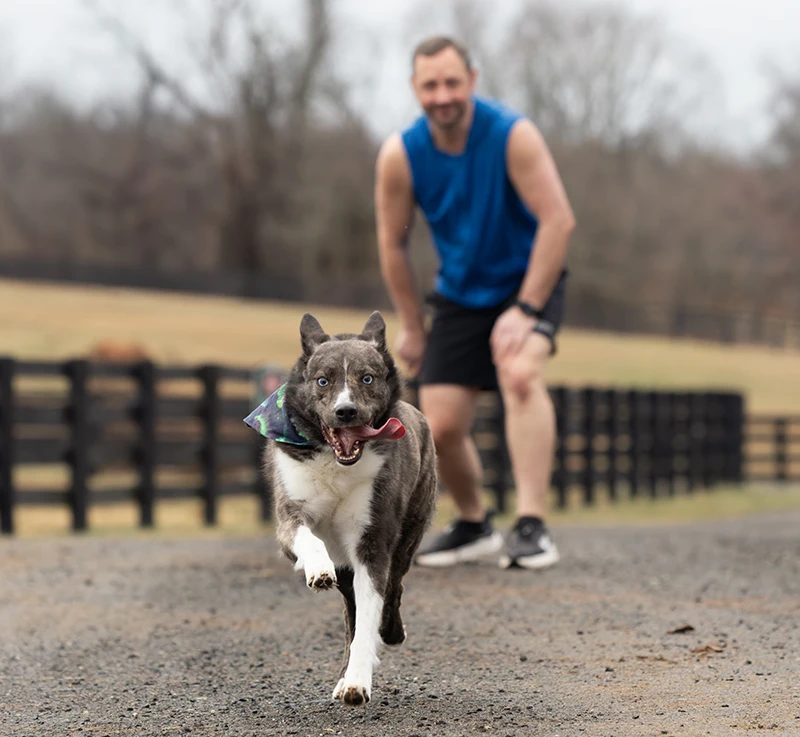
“Last year, when she was just 6, I noticed she was a little stiffer.”
“Normally, when I come down in my running clothes, Aurora knows it’s time for a jog. She’s like, oh, game on. It’s get out and go time! She’s always been very much out in front on our runs, pulling me along… a total Husky. But I started to notice she was jogging beside me more and more often, and then not long after, she was dragging behind. That was a red flag.
“Now, I treat a lot of arthritis in my practice, and so I very quickly realized that Aurora was suffering from progressive knee osteoarthritis. Pretty soon after diagnosing her, I decided to treat her with Synovetin OA, a very localized approach to this disease that is designed to treat the inflammation causing the joint damage and pain right at the source. In fact, it’s the most potent anti inflammatory I have, and I’ve used it with excellent results in around 200 dogs to date. So, for my own dog, for Aurora, choosing Synovetin OA was a no brainer.
“She did just great with Synovetin OA. I gave her a few days off following the injection and then had her out walking the first week. We got back to running 3 or 4 weeks after that and were back up to 5ks within 6 weeks. That was in September of 2025, and I can’t remember the last time she needed pain meds. She had just a fantastic response to Synovetin OA.”
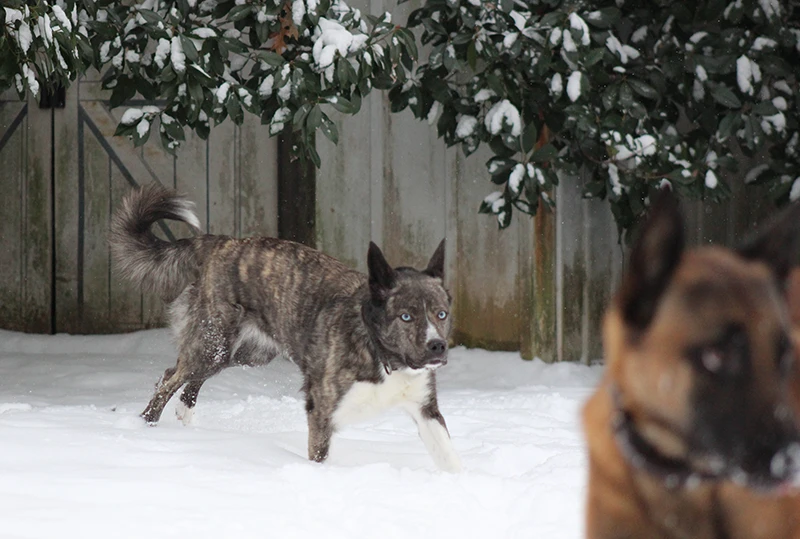
“If Aurora’s story tells us anything, it’s how important it is to find OA early.”
“That’s what I tell my pet parents. You know your dog better than anyone. If they’re doing something different, moving a little funny, lagging behind like Aurora was, they’re probably in pain and the sooner you talk to your vet the better.
“Arthritis in dogs is not a disease purely of old age. We see dogs as young as FOUR months starting to have problems with their joints. And we need to be treating them with the various tools at our disposal as soon as possible. Weight management is huge for these animals. I keep Aurora pretty lean and that makes such a difference not only for her joints, but for her overall health as well. I can’t stress this enough with pet owners.
“Then there are various pain relievers and supplements we can give and joint injections like Synovetin OA that we can use to help these dogs feel comfortable and get back to their active selves. What I particularly like about Synovetin OA is that it’s non systemic. By that I mean it’s not a pill or a shot that exposes the dog’s whole body to a drug as it travels through their systems to reach the joint. Synovetin OA is injected right into that joint where it goes to work to fight inflammation without going anywhere in the body that it’s not needed.”
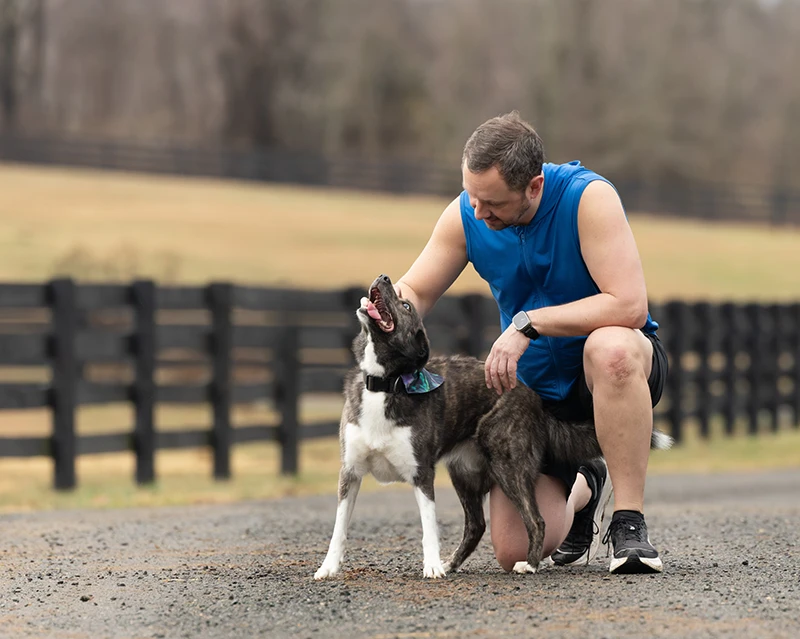
“For Aurora and me, Synovetin OA was a great option.”
“With Synovetin OA, I can be very focused. I can do something to get that dog feeling better quickly. I can directly treat the inflammation in the joint that’s degrading the cartilage and leading to disease progression. And I can do it with just 1 injection that lasts up to a year or even longer as I’ve seen with some cases. Those are many of the reasons that I chose this treatment for my own dog. Again, for us it was a no brainer.”
What do other pet parents think about Synovetin OA? These owners had their dogs treated with Synovetin OA and now have good news to share!
Get their stories here.